Archive for category Newsletter

April Newletter

EVERGREEN CHRYSANTHEMUM ASSOCIATION
Seattle, Washington
ECAMumClub.org

Jim Anshutz, Secretary

MEETING OF THE ECA –THURSDAY April 08, 2009 at 7 PM at the Seattle Police Athletic Association Office (SPAA) site at 11030 East Marginal Way South, Tukwila.

TELEPHONE COMMITTEE MEMBERS contact your phone list members early, as your calls do help to increase attendance.

CHRIS BROOKS
We wish Chris a speedy recovery from his recent gall bladder surgery and thank him for his devotion to the Club!

YEARBOOKS –Mark Ross said that the 2010 ECA Yearbooks may be available for distribution to members attending the April meeting. (He is till trying to determine a final list based on membership payments.) If a membership roster isn’t completed for 2010, a draft copy will be available at the April meeting for review of member information and any other final touches.

A big thanks to Mark who once again took on the Yearbook duty which required lots of time and effort. It’s a big job and is greatly appreciated.

PLANT SALES – Thanks to Bob Ewing for all his hard work coordinating our public plant sale and thanks to the large number of Club members who helped out at the sale at Furney’s which was very successful. (We’ll await final numbers as Chris recovers from his surgery.) For anyone who may still need plants, Ron Elliott, Bob Ewing and Mark Ross have the leftover plants that they will bring with them to the April meeting.

MEMBER NEWS – Again, the E.C.A. appreciates all the time and effort all the growers who took the time to propagate plants to sell at our membership and public plant sales. The Public Plant sale and our membership dues are the club’s only means of income to cover the club’s yearly expenses. Thanks to all of you, GOOD JOB.

WELCOME NEW MEMBERS who joined during the plant sale at Furney’s. They are Chris Binz, Tamara Bliley, Richard C. Blaisdell and Ann Sibborn and we hope to see them at future meetings and events.

PLANT CULTURE and SUPPLIES –April and May are the months where most of our cultivars are stopped. Cultural recommendations are attached for April and will be discussed at the April meeting. Contact Don Stark for soilless and supplies needed.

Please note the change in recommendation for starter fertilizer. Don Stark indicated that water-soluble 10-50-10, Peters Super Blossom Booster plant food, is available at local garden stores or McLendons Hardware in 1.5-pound bags. The application directions indicate 1 tsp per gallon of water for indoor use. Use this fertilizer as a supplement through the 6” pot stage. Peters 20-10-20 will be available for use through the summer growth season.

If you prefer to receive future monthly notices by email only rather than US mail, please send an email to Jim Anshutz. It will also save the Club some money on postage.

APRIL TO DO LIST (edited from DRS 3-21-05)
1. Potting on mums into 4” or 6” pots
• Soilless growers who are using the club recommended M&R mix. This mix is ph balanced at 6.5 and contains a good mix of fertilizers that carry the plant for 3-4 weeks. It requires no additives at this time, but some growers like to add a little Alfalfa meal and some additional pumice for increased aeration.
• Soil or compost mixes: See McGlashen mix in the McGlashen Hand Book. You’ll need to mix your own soil, consisting of compost, or garden loam plus slacked Lime or Dolomite to keep soil sweet plus Steamed Bone to promote root growth. Also, ashes and a little Rose and garden fertilizer (i.e. 4-10-8 or 5-10-10) Pumice or grit may be added to loosen the soil mix.
• Wash previously used pots in a mild Clorox bath (bleach), then rinse in clear water.
• Clay pots are recommended for 4 or 6 inch potting as they breathe and dry out faster during cool April days.
• Pot on when a significant ring of roots forms around the bottom edge of the pot (semi root bound). Do not compact the potting mix. Tie plants to small stakes.
2. Move mum pots outdoors as weather warms. Choose a sunny location.
• Bury pots to rim if using clay. Protect from frost, wind, dogs, cats and Children.
3. Review stopping dates. Most ECA cultivars are stopped Between April 15 and May 30.
• Pinch date lists for most club cultivars should be available at the April meeting. Contact your Coach for other cultivars not on the list.

4 OTHER CARE:

• Control Aphids. Spray for Aphids every 2 or 3 weeks, with liquid Diazinon, or other insecticides. Water only as needed, do not over water.

• Fertilize weekly starting the 3rd or 4th week after potting. Standard Miracle Grow is recommended. Water soluble 10-50-10 Peter’s upper blossom booster is also a good substitute.

• Continue culling process in April to get to your final growing group. The 6” potting should
be used for this reduction. Don’t always keep the first plants to reach 6” potting stage. Keep
the best cultivars. Share surplus plants with other club members. Throw away damaged or diseased plants.

March Newsletter – Plant Sale Issue

EVERGREEN CHRYSANTHEMUM ASSOCIATION
Seattle, Washington
Jim Anshutz, Secretary

MARCH IS PLANT SALES MONTH!

MEETING OF THE ECA –THURSDAY, March 11th, 2010, at 7 PM at the Seattle Police Athletic Association Office (SPAA) site at 11030 East Marginal Way South, Tukwila.

TELEPHONE COMMITTEE MEMBERS contact your lists early, as your calls do help to increase attendance, and please mention the plant sale at Furney’s March 27th 9:00 am-1: 30 pm.

DUES – Members are encouraged to pay 2010 dues to Treasurer, Chris Brookes. Annual dues are $15/member or $20/couple. Dues must be paid before or at the March meeting for members to be listed in the clubs 2010 yearbook.

Bill Hough
We are sad to report that Lifetime ECA member Bill Hough passed away on December 11 of last year. Don Yockey noted that Bill was a good mum grower as well as a good friend. There will be a celebration of Bill’s life on Sunday, March 7 from 11:30 to 2:30 at Maritime Pacific Building (his old Hough Marine & Machinery building) at 1111 NW Ballard Way in Seattle. For those of you with a computer, his obituary was published in last weekend’s Seattle Times. You may view it at Bill Hough Obit

ANNUAL CLUB CALENDAR OF EVENTS (Mark you calendars)

Monthly meetings – 2nd Thursday of each month.

Public Plant Sales – Saturday, March 27
From 9am-1pm at Furney’s (21215 International Blvd (S. HWY 99), Des Moines,WA)

Annual Picnic – Sunday, August 15 We will be visiting Volunteer Park Conservatory and Bellevue Botanical Garden followed by lunch at the Pozniaks in NorthBend.

Aki Matsuri- September 11 & 12 at Bellevue College

Fall Chrysanthemum Show – October 29, 30 and 31 at Furney’s Nursery

Annual Fall Banquet – Thursday November 11 At Angelo’s in Burien

MARCH PLANT SALES – The second members only plant sale of the year is at the March meeting, March 11th.

Members are reminded to bring in their extra plants for our March 11 member plant sale and the March 27 public sales. Only healthy looking plants are accepted for the “Sales Events”. For those bringing in plants, also bring in newspaper or a cloth to cover the table if your plants are in an open bottom carrier. This will help the clean up crew when tidying at the end of the meeting.

Don Stark advises that plant selection is a very important aspect of growing competitive plants. Per Don – “You older hands, if you have grown the same cultivar from your own stock with poor results, throw your stock away and buy a plant or two of that cultivar at the plant sale. Select carefully, you want a healthy cutting, and if the grower didn’t think enough of it to put his initials on the tag, go get a different one. Keep looking for the best stock available.” Don also suggests that you come with a list of plants to assist you in your selection.

Our public plant sale will be March 27th (Saturday) from 9-1:30 at Furney’s Nursery in Des Moines (21215 Pacific Hwy South). At least 8 people are needed for Set-Up on Friday March 26th 1:00 pm to about 2:30 pm. On Saturday about 10 people are needed, A sign up list will be taken at the March 11 meeting. You may also call Bob Ewing to let him know if you wish to sign up.

PLANT SUPPLIES –

Contact Don Stark for soilless orders for the March meeting.

NEW MEMBERS – Welcome to the new members that joined ECA late in 2009 and early this year 20010. New members receive ten free plants the first growing season. (Couples receive 15 free plants). New Members are encouraged to contact Bob Ewing to be assigned a coach who will provide personalized growing instruction and advice. It is highly recommended that new members take advantage of this membership service. Don’t be shy – give Bob a call!!!

Cultural recommendations are attached for March and will be discussed at the March meeting.

MARCH TO DO LIST (edited from DRS 2-21-05)
· Clean pots and gather materials for potting:
- For soilless growers, supplies include soilless mix, Peters 9-45-15 fertilizer, and optionally, ¼ inch screened pumice, perlite or grit. Most of our growers use the M & R Soilless potting mix sold by the club. Addition of the pumice perlite or grit is not necessary for this stage. Generally the pumice etc. is added for the 9-inch potting. Some also add the pumice to the mixture for the 6-inch potting.
- For McGlashen soil mixes, you will need good garden loam; pumice, perlite or grit; and leaf mold or course greenhouse peat, plus well composted manure, steamed bone meal, slacked or hydrated lime and a good dry rose fertilizer such as 4-10-8. See your copy of the McGlashen book for details.
· Pot mums into 4 or 6-inch pot:
- Clay pots are recommended when possible for the 4 or 6 inch potting as these pots breathe and dry out faster during cool March and April days.
- Wash used pots in a bleach/water solution, i.e. 2 teaspoons per gallon of water. Then rinse in fresh water. Let the cleaned pots set in the clear water for 3 or 4 minutes to clear out the bleach. Change the rinse water occasionally to clear out the bleach from previous rinses.
- Pot on when the ring of roots around the bottom of the pot is substantial. Do not compact the mix and leave room at the top for watering.
· Move pots outdoors:
· After mums have become well established in the new pots (1-2 weeks) move mums outdoors or to cold frame to slow the foliage growth and toughen up the plants. The desirable ambient temperature is 50 to 60 degrees.
· To keep roots warm and at a stable temp, bury the pots in the soil or in a layer of compost or manure. Six inches is a good depth for the compost or manure. A cold frame is the best solution for this stage!
· Lacking a good sunny location, B-9 is a growth retardant spray mix that tends to help plants from getting too leggy. It is available through the club.
· Stopping Dates:
· Review stopping dates and stop mums as their stopping dates arrive. Very few varieties require pinching in March unless a double pinching regimen is being followed (Phil Houghton March 15 and May 15 for example).
· Refer to the various ECA lists of stopping dates. Copies of a stopping date list will be available at the meeting.
· Keep growing vigorously:
· Water as needed, but keep relatively dry
· Spray or control aphids
· Fertilize soil less plants with 9-45-15 or Miracle Grow solution starting the 2nd or 3rd week after potting. Use fertilizer at ½ strength that is approximately ½ teaspoon/gallon.
Begin culling process in March to get to the final growing group. Send surplus
quality plants to plant sales or share with other ECA members. Throw away poor
plants and damaged or diseased plants.

Tags:

February Newsletter

EVERGREEN CHRYSANTHEMUM ASSOCIATION
Seattle, Washington
Jim Anshutz, Secretary

HAPPY VALENTINE’S DAY

MEETING OF THE ECA – is scheduled for THURSDAY FEBRUARY 11, 2010 at
7:00 PM at the Seattle Police Athletic Association Office (SPAA) site at 11030 East Marginal Way South, Tukwila.

TELEPHONE COMMITTEE MEMBERS Call your lists early in the week of February 1st as your calls do help to increase attendance.

ECA MEMBERSHIP

Dues have not yet been received from several members. The cost is $15 per member or $20 per couple. Only paid up members names can be included in the 2010 year book. Checks payable to ECA should either be mailed to: Christopher Brookes or paid at the February meeting. If a member has any doubt whether they have paid or not please check with Chris. Thank you

Harry Hasegawa Memorial

Bob Ewing reports that Harry Hasegawa died recently due to kidney failure. Bob mentioned that while Harry had not been active recently in our club due to health reasons, he nevertheless always had a big collection of Fairweather mums around his cottage at Wesley. Bob said that when he and Mary Lou moved in recently, Harry came down to welcome them to the place. Jill Aldrich sent a card to Harry’s wife Anna and the family from the ECA. A memorial celebration will be held at 2 P.M. on Saturday, Feb.13th at Wesley Gardens (815 S. 216th St, Des Moines).

MEMBER PLANT SALE – The first member plant sale of the year occurs at the February 11th meeting. ECA growers will bring a few plants to the meeting for sale to help other members who do not start plants from cuttings secure plants for the coming growing season. Plants available for the first sale are generally the late blooming varieties that are in classifications 1 through 5. The cost of each plant will be $1.00 for members.
(New members receive ten free plants for the first growing season.) No more than five free plants should be selected at the February sale. This helps assure the new grower success managing the early season growing challenges and also greater access to a wider selection of plants such as the early blooming varieties which are easier to grow and are more available at the March member sale (March 11th Meeting) and at the Public Plant sale.

Public Plant Sale

Mark your calendars for the Saturday March 27th Public Plant Sale at Furney’s Nursery (21215 International Blvd, Des Moines, WA). We will recruit volunteers to help with the sale at the February and March meetings.

NEW MEMBER COACHING

New Members are encouraged to contact Bob Ewing to be assigned a coach who will provide personalized growing instruction and advice. It is highly recommended that new members take advantage of this membership service. Don’t be shy – give Bob a call!!!

MUMS REQUESTED BY PATRONS FOR 2009 and presumably to apply for 2010 also:
Golden Rain, Connie Mayhew, First Light, Woolmans Century, Ice Box, Alabama, Lundy, Mt Rainier, Morning Star, Honey, Powder Puff, Elsie Prosser, Revert Equinox, Chase Wakes, Elizabeth Shoesmith, Red Woolmans Glory –red & yellow, Anzac , Mary Jane, Atomic, Cossack, Tennis, Pumpkin, Primrose Tennis, White Billy Bell, Bullfinch, Port Stanley, Purple light, Seatons Ruby, Vienna Waltz, Kermit, Gillette, Ogmore Vale, Seigi, Cherry Venice, Fairweather, Koshi no Yuki, Talbot Parade, Lilli Gallon, Lava, Vicky and Max Riley.

If you have other requests, bring them to the February 11th meeting.

PLANT CULTURE – Continue to start plants for our public sale in March. Plants must be given protection for the first few months and carefully nurtured to establish strong root systems before potting or repotting. In February, take starts for the early blooming varieties. At this month’s meeting, the focus is growing plants, cultivar selection, materials and your reference books. Cultural recommendations are attached.

SUPPLIES – Some supplies will be available at the February meeting.
• Plant Labels, White and Yellow 100 per pack.
• 2½” Plastic planting/starting cubes
• M&R Soilless Growing Media The cultural committee decided to provide only M&R mix for sale since it is a better product for mums than the mix used previously. This mix can be used for all pottings from the first 2 ½” pot to the 9 or 10” final pot.
Contact: Don Stark before the February 11th meeting if you wish to buy Soilless.

February to-do List (New: 1-28-06 DRS)

Continue with cuttings:

Continue taking cuttings throughout Feb. and into March for some varieties. A few early Feb. cuttings can be available for the March Plant sales (sale at the March meeting and the public plant sale on Sat. March 27). Most Feb. and March cuttings should be of the early English and American varieties. Late Decorative) Classes 4, 5, 14 and 15) should be started primarily in Feb. Take cuttings for yourself and for the plant sale.

Most varieties in classes 1, 2 and 3 should have been started by the end of January: however –here are some varieties that can be successfully grown from Feb. cuttings. #1 & #2’s Lundy, Yellow Lundy, David Dando, Ralph Lambert, Yellow Ralph Lambert, Athabaska, Harry Gee, Jane Sharpe and Seychelle;. #3’s Len Hall, Salmon, Primrose and yellow Fairweathers, Stockton and Heather James.

Cuttings started directly in the cutting bed media should not require fertilization before potting on. If you are starting in the cross bottom bands or 2” clay pots, fertilizer should be added after 3 to 4 weeks as these cutting generally require 5-6 weeks before potting on. Start fertilizing once a week beginning with the 4th week. Use an early Mum fertilizer, Peters 9-45-15 or Plant Marvel 12-45-10 (One Tsp/Gal once a week)

Potting on:

Most growers are using the soilless M&R potting mix sold by the club. In general no additives are required for the early pottings (2” and 4” pots); however some growers like to add some special ingredients. For instance Alfalfa meal or pellets is a good stimulant that can be added. Avoid adding Bone meal, as you will probably find fungi growing on the top of your pots due to too much potassium.
- Pot the mums directly from the cutting beds into 2” pots, or from the starter bands or pots into 3” or 4” pots.
- Use new pots, or wash previously used pots with a mild bleach solution (Clorox) to kill moss and eliminate the viruses. When bleach is used thoroughly rinse pots in fresh water to get the bleach out of the pot.
- Clay pots are recommended for the 2”, 3”, 4” and 6” potttings as the clay pots will dry out better than plastic after watering. This is especially important during the cool March and April days.

- Pot on from cutting beds when the roots are ½ to ¾ in. long (Typically 4 weeks) into 2 ½” or 3” pots.

- Pot on from cross bottom bands, or pots when roots are growing thickly out of the pots or bands (Typically 6 weeks). Do not compact the mix!

- Place the newly potted mums out of the light or under the bench for 2-3 days to stimulate root growth.

Care:

- Shelter mums in the greenhouse, cold frame, or other shelter (Kitchen table or south facing window)
- Temperature should be between 50 and 60 degrees.
- Glass overhead will help keep mums from getting leggy.

Care Continued:

- B-9 is a good growth retardant that tends to help plants from getting too leggy. It is available through the club. If you choose to use B-9 it should be applied at the time of potting on and again at or near pinch time. Caution: Do not use B-9 on plants that tend to naturally grow short: i.e. all the Fairweathers, all the Alexis, Port Stanley and others.

- Plants will remain in this first potting for 4-6 weeks until they have produced a noticeable root ring around the bottom of the pot. Don’t be afraid to knock the root ball out of the pot after several weeks and examine the roots.

- Fertilize with 9-45-15, or 12-45-10 beginning the 4th week (1 Tsp/Gal once a week) These fertilizers are available through the Club at the monthly meetings.

January Newsletter

EVERGREEN CHRYSANTHEMUM ASSOCIATION
Seattle, Washington
HAPPY NEW YEAR 2010

HAPPY CHRYSANTHEMUM GROWING 2010

MEETING OF THE ECA – Our monthly meeting is Thursday January 14th at 7 PM at the Seattle Police Athletic Association Office (SPAA) site at 11030 East Marginal Way South, Tukwila. Wa.
MARK YOUR CALENDAR: Once again it is time to mark your yearly calendar for EVERY SECOND THURSDAY OF THE MONTH 7:00 pm for our Monthly Chrysanthemum Meeting. Please join us to exchange your growing experiences with all of us and let’s learn from each other and have a fun evening out.
TELEPHONE COMMITTEE MEMBERS – Please contact your call lists early in the week of January 3rd.. If it is not necessary to give you a reminder call please call Jack Brandon and tell him to take you off the list.

VOTING FOR THE 2010 OFFICERS FOR THE EVERGREEN CHRYSANTHEMUM CLUB WAS POSTPONED UNTIL THIS COMING MEETING ON JANUARY 14th, 2010.

2010 CLUB DUES – Members are encouraged to pay dues for 2010. Annual dues are $15/member or $20/couple. Dues are paid to the ECA Treasurer, Chris Brookes. (Make Checks out to ECA)
CULTURAL NOTES and SUPPLIES – Cultural recommendations are attached for January and will be discussed at the meeting. Early season supplies including plant tags, 2½” plastic cubes (pots), and a limited amount of early season fertilizer and soilless potting mix will be available at the meeting. For those interested in the soilless potting mix, call Don Stark with your orders as soon as possible.
PROPAGATION OF NEW PLANTS/CUTTINGS
Bob Ewing will set aside time to show any member who is interested in how to take cuttings and generate new starts for 2010. Don’t be shy – give Bob a call!

.
WE LOOK FORWARD TO SEEING EVERYONE AT THE MEETINGS NEXT YEAR
PLEASE BRING SUGGESTIONS TO THE MEETING ON HOW WE CAN INCREASE/IMPROVE ATTENDANCE AT THE MONTHLY MEETINGS.
Supplies available for the Jan meeting and prices are :

M&R soilless mix (1 cu ft.) $5.00
Five in. labels, (100 per bundle)white $1.75
“ Color $2.00
2 1/2 in cross bottom bands $0 .05 each
4 in. Twistems 3 bundles for $1.00
6 in. Twistems 2 bundles for $1.00
8 in. Twistems 3 bundles for $2.00
B-9 as marked

Don Stark
January to-do List – (Revised 1/2/06, DRS)
Success for the upcoming growing season begins with the taking of new cuttings needed for ourselves, other club members and for the upcoming public plant sales. Taking the cuttings and potting on the newly rooted cuttings are the major January activities. Hopefully we have kept last years’ stools alive and have added some 20-10-20.fertilizer. At 55 to 60 Deg room temp. our stools should now be producing the strong shoots we need.
Timing:
-Cuttings for classes #1 and #3 should be taken in late Dec. and all of January.
-Most #2 varieties are started throughout January: but Keith Luxford, Ivor Mace and
James Bryant should be started in Dec. or early January, if the stools are far enough
along to produce healthy cuttings.
-Cuttings of classes #4, #5, #14’ & #15 are usually started in late Jan. or Feb.
-Plants to be grown for Specimens (11 or more blooms) should generally be
started earlier, Nov. Dec, or Early Jan. for example.
- Spiders Quills and spoons are also good candidates for January starts.
The cutting bed
should be a flat four-sided box with heating cable, mat or other devices for heating the cutting medium. The box should be at least 18 in wide so that it can hold 1 or more of the 17 in by 9 in. flats. An overhead Fluorescent lamp such as a 4-foot, two-bulb shop light will provide needed light supplement for the new cuttings. Plantgrow or GrowLux bulbs are good but expensive and simple white bulbs seem to work adequately. Fill the box with 2 ½ to 3 inches of cutting media and provide heating controls to maintain the required temperature.
– Cutting bed media -A 50-50 mix washed sand and peat moss
– Cutting bed Temp -65 to 70 deg F.
Taking the cuttings:
We offer two different methods for handling the initial cuttings:
1. Place the cutting directly in the cutting bed media, maintain cutting bed heat at 65 deg
(In approximately 4 weeks the new cuttings will have roots 1 in. long and are ready to
be transplanted into 2 ½ or 3 inch pots.)
2. Fill the 2 ½ in cross bottom bands with our standard M&R growing mix. Set these
bands directly on top of the cutting media and insert your cuttings directly into the
M&R mix. Maintain cutting bed Temp at 70 deg. In 5-6 weeks the cutting should be
ready for transplanting into 4 in pots.)

The cuttings should be from 1 ½ to 2 inches long with the cut off or break at the bottom of a leaf node. It is recommended to dip each cutting into a mild insecticide/fungicide solution (1/4strength). Then dip the base into Rootone or other rooting hormone before setting the cutting into the growing media.
Cover the newly taken cuttings with a glass or clear plastic cover for up to 3 days after taking the cuttings. Leave some room under the cover so that air can get in and circulate around a bit.
Keep the cuttings moist. Don’t let the bottom of the bed dry out

Place a plant label with each cutting Label should contain the name and classification of the cutting, the date of the cutting and the grower’s initials. For example
Charlie’s Mum, (1Y)
DRS, 12/30/05

December Newsletter

EVERGREEN CHRYSANTHEMUM ASSOCIATION
Seattle, Washington
Jill Aldrich, Secretary

HAPPY HOLIDAYS
HAPPY TURKEY DAY, MERRY CHRISTMAS

MEETING OF THE ECA – Thursday December 10th at 7 PM in the classroom facility to the left as you drive into the SPAA complex. Seattle Police Athletic Association Office (SPAA) site at 11030 East Marginal Way South, Tukwila, WA.

TELEPHONE COMMITTEE MEMBERS – Please contact your lists early in the week of December 1st.

NOMINATION OF 2010 CLUB OFFICERS – The December meeting includes the election of officers for the upcoming year.

Nominees:

President Vice President
Chris Brookes Treasurer Jim Anshutz Secretary and welfare com.
Past President Ron Elliott

Don Stark and Mark Ross, Cultural

Trustees 3 year term:
2 year term: Jack Brandon – Steve Backstrom
1 year term: David Rynes Mas Tamekuni

Nominations are encouraged from the floor at the December meeting for all officer and trustee positions. It is up to all of us to rotate as officers periodically to provide the club fresh ideas and new perspectives.

MANY THANKS to Jean Smith and Sydney Ogilvie for organizing all the refreshments.

The club commends the faithful service of Jack Brandon, Chairperson and all the telephone tree callers. Many Thanks

2010 CLUB DUES – Members are encouraged to pay dues for 2010. Annual dues are $15/member or $20/couple. Dues are paid to the ECA Treasurer.

DECEMBER TO DO LIST – (adapted from DRS 12/03/98 notes, Modified ll/26/04) Success for the upcoming year begins with the care of our stock to produce the quality cuttings needed for other members, our club plant sales and ourselves. It is important that you identify your best plants of each variety and try to get your cuttings from those plants. Weak or diseased plants should be destroyed. Get a new start from another member at the plant sale if your stock is weak.

Cultivars in classes #1, #3 and#4 are usually started in late Dec. and January. The #1 varieties such as Jessie Habgood, Gigantics, Mark Woolman, Dukes and Lancaster Fold need early starts and so do the Fairweather family of #3’s. Most #2’s can be started January. Cultivar classes #4 & #5 and 14 & 15”s are usually started in Feb and March. Plants to be grown for specimen (10 or more blooms) should be started ASAP. In spite of the above suggestions for starting times. It is always a good idea to wait on the cuttings till they are ready. Cuttings should be 1” to 2” and growing vigorously.

PREPARING STOOLS FOR CUTTINGS
+ Keep pots outside and sheltered from the wind, cold, rain and slugs. It is
important for the plant stool to chill and remain relatively dry during its
dormant period until 2-4 weeks before you want to start taking cuttings.
The chilling period will produce much stronger cuttings for the next
growing cycle.
+ Protect stools from hard freezing (less than 28 degrees). Most plants
can stand a night or more of freezing temperatures but three
consecutive hard freezing nights will probably kill all but the hardiest
cultivars. During severe cold snaps a garage, shed, greenhouse, or
a tarp can be used temporarily to protect the plants until the cold
subsides.
+ Two to four weeks before the desired cutting-time bring pot stools
into heated area (60 degrees for example) and feed with a
nitrogen fertilizer such as Miracle-Grow to stimulate new growth.

TAKING CUTTINGS
+ The recommended cutting media is a 50% sand 50% Peat Moss.
However, I and others have recently switched to starting in the
M&R soilless mix that we pot into for the rest of the year. I start
Right in the 2 ½ or 3 inch pots and set them in or on the bed of
Sand in my cutting bed. I also start some of the later varieties
Directly in the 2 ½ plastic cubes that we use mostly for plant sales.
+ The cutting bed temperature should be maintained at 65F.
+ Cover the newly taken cuttings with a glass or clear plastic cover
for the 3 days after taking the cutting.
+ Cuttings should be from 1 ½ to 2 inches long with the cutoff or
break at a leaf node.
+ It is recommended to dip cuttings in a mild insecticide/fungicide
solution before setting the new cutting in the cutting media.
+ Cover the newly taken cuttings with a glass or clear plastic cover
for up to three days after taking the cuttings. Leave some room
under the cover so that air can get in and circulate around a bit.
+ Provide overhead light for the new cuttings. A 4-foot fluorescent
shop light with Growlux bulbs works great.

Don Stark’s Top Ten Mum Varieties
1. Connie Mayhew is a #2 yellow that everyone should grow. Ed
Pawlowski has won best bloom open classes with it.
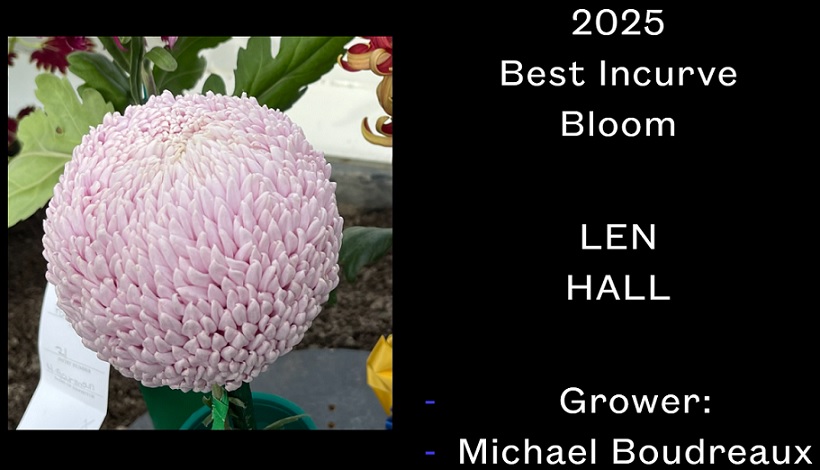
2. Len Hall is a #3 pink incurve that is reliable and in his opinion
the best #3 in our club.
3. Port Stanley is a #5 yellow incurving bloom with good form and
Color that does well with 4-5 blooms per plant.
4. Lundy and Yellow Lundy are #2 reflex varieties and in his view
the best #2 blooms in our club. You will love the yellow and the
white is brilliant. These are winners.
5. Seychelles is a #2 dark pink reflex that is big with good form
and likes a lot of fertilizer. Don Stark won best in show with a Seychelles last year.
6. Fairweather family (Pink, White, Salmon, Primrose Yellow)
Produces all good #3 incurves. The Primrose and yellow varieties are new and very healthy and vigorous.
7. Ralph and Yellow Ralph Lambert are #1 bronze and yellow
reflex varieties that are easy to grow two up.
8. Alexis and Apricot Alexis #5 pink and apricot varieties that you
will love to grow.
9. Stan Addison is a good #5 new comer, it grows fairly big as a
#5 when grown 2 or 3 blooms, and can be grown successfully
as a #3 when grown 5 to 7 blooms per plant.
10. Vienna Waltz is a #10 purple spider that is one of the clubs
best varieties in this class. It blooms on time, beautiful and a
winner.
If you wish to continue receiving the Newsletters and “To Do Lists I encourage you to pay your dues for 2009 by January, so you are not dropped from our Database. By-Laws, Article 1, states that fees are due no later than the March meeting for members who have paid dues in 2008.

AWARDS BANQUET: Our Banquet at Angelo’s in Burien was great and everyone had a nice time. There were 34 members and spouses in attendance.

Many Thanks to Don Stark in preparing the trophies that were presented. They looked great. Also many thanks to Larry Mayer who made arrangements for the Engraved Chrysanthemum Plates and generated all the Certificates for the winners.

CULTURAL NOTES The cultural for the December meeting will include a review of the last growing season and cultivars response, planning for the upcoming 2010 growing season, and getting new plant starts growing well. Refer to the cultural page for Don Stark’s recommended top ten mum varieties for 2010

Looking forward to seeing everyone at the December meeting, come and vote for your choice of Officers for 2010

I will send out the results of the voting for the 2010 Officers.
Attached is the “To Do List for December”.

Have a Merry Christmas, see you in the New Year.

Jill Aldrich, Secretary

November – Banquet

ECA Awards Banquet Thursday November 12th

No Host bar @ 6 PM
Dinner @ 7PM
Location: Angelo’s 601 Southwest 153rd ST Burien, WA 98166

Angelo’s Website has Map & Directions: http://www.angelosofburien.com/

Cost is $20.00 per person. Please send payment to Chris Brookes.

Menu choices are: Prime Rib Chicken Vegetarian Lasagna
Dinners include salad, vegetable, coffee, water and desert.

If you have not signed up, please e-mail or phone Steve Backstrom
and leave a message Slowly & Clearly stating your name
and if you want Prime Rib, Chicken or Lasagna.
Also please call if you need a ride or need to be picked up at Ferry,
Bus or Train Station. The restaurant is a three block walk from the
Burien Transit Center.

Please don’t hesitate to call or e-mail any other questions, comments
or feedback.

Please bring any blooms or displays that you wish to share.

This will be a lot of fun!

America’s Premier Mum Show

Furney’s Nursery cordially invite’s you to attend the Evergreen Chrysanthemum Association’s Show at 21215 International Blvd(HWY 99) in Des Moines, WA. Dates are Friday October 23 from 1PM-6PM, Saturday October 24th from 9 AM to 6 PM and Sunday from 10 AM to 3 PM.

See hundreds of large exhibition English Mums and amazing plant culture.

Free to the public. Come see and view the season’s results of this fascinating hobby!

Aki Matsuri September 12th & 13th

The 12th Annual Japanese Cultural Arts Event (Aki Matsuri)

Date: September 12 and 13, 2009
Time: Saturday (10 a.m. – 6 p.m.) and Sunday (11 a.m. – 5 p.m.)
Location: Bellevue College (BC), Main Campus
Buildings: Gym, C-Bldg. & R-Bldg.
3000 Landerholm Circle SE, Bellevue, WA 98007
Contact: info@enma.org
Website: www.enma.org (has links to BC & Campus Map)
Cost: Admission & Parking are free. Fees apply to some workshops.

Japan comes to Bellevue College for a weekend! A two-day program of Japanese cultural and educational events for all ages. Join with thousands of other visitors to celebrate Japan’s traditional and rich cultural heritage.

The matsuri includes 2 full days of on-stage Japanese Performing Arts, Japanese Martial Art demos by local dojo members, Puppet Shows based on Japanese Folk Tales, Tea Ceremony demonstrations in the Teahouse, 65+ Exhibit booths, and Japanese food booths. Browse through “Nomi-no-ichi … a Japanese style flea market” to make a lucky find! Meet with “Hello Kitty”!

This year’s features are:

Tsugaru Nuri (Lacquerware) and Tsugaru – Exhibit & on-going demonstration by Tsugaru Nuri Craft person, Kozo Fujino, and lecture on Tsugaru region (3 PM at Classroom C164 on both days) by Tsugaru District Researcher, Anthony S. Rausch (PhD), from Hirosaki, Japan.
Yakumaru Nodachi Jigenryu (one of the ancient Martial Arts of Japan) – A group of twelve (12) members from Kagoshima Headquarters and Tokyo branch of Yakumaru Nodachi Jigenryu Hozonkai lead by Head Master & President Ryuichi Higashi will give Hono Enbu demonstrations from 1 p.m. on both days. Prior to the demonstrations each day, Professor Hisashi Takahashi will give special Power Point presentations in English to introduce the history of Yakumaru Nodachi Jigenryu (12 PM at Classroom D101).
18th Annual Koi Show presented by Washington Koi & Water Garden Society with more than 200+ koi on display, judging Koi, Koi sales, lectures, and more!

Where else can you shop, eat, and browse so many diverse and interesting family activities in one location? Yes, there really is something for everyone!

To learn more about Aki Matsuri 2009, please visit www.enma.org

September 2009 Newsletter

MEETING OF THE ECA – THURSDAY September 10th , 2009 at 7 PM at the Seattle Police Athletic Association Office (SPAA) site at 11030 East Marginal Way South, Tukwila.

TELEPHONE COMMITTEE MEMBERS call your lists early as your calls do help to increase attendance.
ANNUAL GARDEN TOUR – The annual garden tour and picnic was Sunday August 8th.
The tour viewed a variety of gardens with many Chrysanthemums. It turned out to be a nice day. The tour visited the gardens of Bob and Mary Lou Ewing (who supplied refreshments to help us wake up). Many thanks to Don and Jane Stark for letting us see how their chrysanthemums are doing, the tour concluded with a potluck picnic at Rich and Julie Pozniak’s beautiful home. It was a great picnic; thanks to the Pozniak’s hospitality and all who brought such delicious dishes for everyone to enjoy. We had 19 members in attendance. A good time was had by all.. Thanks also to Steve Backstrom for giving me driving directions to the Pozniak’s and also thanks to Don Stark for their directions as well.

Special Thanks to the members who opened their gardens for us to tour, it was a pleasure. Special Thanks to Rich and Julie Pozniak for Hosting the Picnic. I would like to also express Our Thanks to Jack Brandon for coordinating the telephone tree helpers and notifying members of the events; this contributed to our great turn out for the garden tour and picnic. Many Thanks to all the great cooks.

For those who already have mature blooms, consider entering them in the Puyallup Fair. For information about the fair, go to www.thefair.com on the internet. Select Entries and Floral and the Chrysanthemum section to obtain the Puyallup Fair Show Schedule. Those exhibiting at the fair get free admittance to the fair for the day.

SEPTEMBER MEETING: This is a very important meeting as we begin to prepare for our annual show October 24th and 25th (Set-up Wed. Oct. 21st). Judging Friday Oct. 23rd at Furney’s Nursery, 21215 International, Blvd. and Pacific Hwy. S.

Just a reminder that the Aki Matsuri (Fall Festival) will be held September 12th and 13th at Bellevue Community College. Our club is having an exhibit there. Maybe some of our ECA members will have some blooms to show off there.

LOOKING FORWARD TO SEEING EVERYONE AT THE MEETING, IF RIDES ARE NEEDED PLEASE CALL SOMEONE LIVING IN YOUR AREA.

PLANT CULTURE and SUPPLIES: – The September meeting will devote time to the care and feeding of the blooms as they develop; Club supplies will be available, place orders for specific items with Don Stark. Cultural recommendations are attached. With possible rain or showers consider your sheltering options for September as we move to the latter part of the growing season.

SEPTEMBER TO DO LIST – (adapted from Don Stark 9/98 notes)

Once the buds have broken the membrane and some petal tips are showing, it is time to get the pots into or under some kind of shelter. The basic idea is to protect the blooms from rain and dew. If rain or dew is present when the sun strikes, you will almost certainly burn the florets. Shelters come in a variety of sizes, names, and shapes including porches, large overhanging eaves, garages, greenhouses, and temporary wood and plastic structures.

Sheltering Plants During the Bloom Cycle Starting September 1
• Shelter requirements are daytime light (though it can be shady), ventilation, and temperature control.
• Maximum temperature should be kept below 80 degrees F if possible. Above that temperature the probability of bloom damage due to petal rot is high. If the shelter is exposed to too much sun in the early Sept days, the temperature within the shelter can skyrocket.
• Big fans keep the air moving and the temperature down. Fans also hopefully can bring air from a shady side of the shelter to cool the overall area as well.
• Lining the inside of the shelter with old sheets or muslin will also reduce the heat and filter the sunlight.

Bring Pots Into Cover
• Wash the pots to get rid of the crud and residue from the growing area.
• Pick off old dead and damaged leaves (mostly at the bottom of the plant) that harbor pests and fungus.
• Spray the plant with a fungicide and insecticide before taking to the shelter.
• Watch for and destroy earwigs. They wreck blooms when they get inside.
• Top-dress the pots again. Put about ½ to ¾” of the 9-Inch mix or Soilless mix on the surface of the pot and level it. Top-dressing the plants helps finish plant growth now and also promotes shoots on the plant stools for our next growing season.
• Optionally, add ¼ teaspoon FeSo4 to enhance color. Do not add to plants with white or yellow blooms.
• Add ¼ teaspoon of Potash to help harden off the plant and keep the blooms from being too soft.

Plant Clean Up and Cut Back to Final Lateral Count
• As the plant goes to shelter, if not already done, cut back to the final lateral count selecting the best overall laterals. For #1’s keep 1 or 2 blooms per plant, #2’s keep 2 blooms per plant, #3’s and others excluding specimen plants keep 2 to 5 blooms per plant.
• Stake and tie up the selected laterals and add support shingles for the blooms as you house the plant.
• Remove or pick off the side laterals on the selected stems.

Fertilizing & Watering
• For late season fertilizing, reduce fertilizer to ½ strength for 2-3 weeks. After the petals start to fall, gradually increase feed. Switch to a higher potash fertilizer along the lines of a 15-10-30 or other bloom feeder fertilizer and go lightly.
• Watering is different at this stage as the plants are kept a little dryer at this stage. Water plants more sparingly, using about 1 pint per watering. Do not water when the temperature exceeds 75F.
• There are two schools of thought as to the best time of day to water. Previous year cultural notes recommend to water in the evening as the day is cooling down to help avoid sending the plant sap to the blooms in heat of day and blowing out or cracking the bloom neck. Bob Walker recommends watering in the early part of the day.
• Water/fertilize from a bucket using a 1-pint jar or similar small container. Do not use the hose and spread water everywhere on the shelter floor. Keep the finishing area dry and clean.

August 2009 Newsletter

ANNUAL GARDEN TOUR AND POT LUCK PICNIC

AUGUST 8TH, 2009

2009 GARDEN TOUR The annual ECA garden tour and Picnic is scheduled for Saturday, August 8th.   The 2009 garden tour will  be in the South end and will finish with a picnic at  Rich Pozniak’s home in North Bend, WA . Picnic is Pot Luck and at the July meeting, there was a sign up sheet provided.  Club members can still sign up and attend..

TELEPHONE COMMITTEE MEMBERS call your lists early as your calls do help to increase attendance. Please ask if they are attending the garden tour and pot luck picnic and confirm what they will bring and give a count of members attending and dishes they will bring to Steve Backstrom.

For those going on the garden tour, we will meet at Valley Ridge Park on 188th and 46th Ave. South, next to Tyee High School.   The tour Caravan will be leaving at 9:30am sharp.  Scheduled stops for the tour include the homes of Bob and Marylou Ewing, Don and Jane Stark and then on to Rich and Julie Posniak’s home for a tour and picnic.  Tour order and maps for the tour destinations will be provided at the meeting place, Valley Ridge Park on 188th and 46th Ave. South. The tour will proceed as a caravan from there.   Carpooling is encouraged.  Following is a list of the addresses for the scheduled stops.

Valley Ridge Park on 188th and 46th Ave. South leaving at 9:30 sharp

First Stop, Bob and Marylou Ewing’s to see their beautiful garden.  Next we continue to Don and Jane Stark’s garden and see what Don is growing this year. We will then proceed to Rich and Julie Posniak’s garden  where we can not only enjoy his Mums, but also have our annual Pot Luck Picnic.  Members who cannot make the tour may proceed directly to Rich and Julie Posniak’s  in North Bend. Plan to arrive there between 11:00 am and 12:00 pm.

Members should receive a call from the Club’s telephone tree committee this week to determine an estimated head count of those planning to attend and their potluck contribution (hot dish, salad, or desert) to assist the picnic planners.

LOOKING FORWARD TO SEEING EVERYONE AT THE PICNIC

PLANT CULTURE and SUPPLIES: Place orders for specific items with Don Stark.  Cultural recommendations are attached for August and September.  It is time to consider your sheltering options for September as we move to the latter part of the growing season.

Member News

Here is some news about the Walkers next door that is of interest to our ECA group.  Laureen had a stroke last Thursday.  Per Bob, the only thing affected was her walking as she has to walk with a walker.  She is currently at the Avalon Care Center in Federal Way.  Bob recently had day surgery last Thursday.  (Sent to me by Mark Ross, former ECA President)

Happy Anniversary 53rd for Bob and Mary Lou Ewing.  August 4th CONGRATULATONS

REMINDER:

Ron Elliott, President, would like to remind all members to work on their List/Inventory of the

Plants you are growing and any stools that you will retain and propagate.  If you haven’t already submitted your list of Cultivars please complete it and have it ready for the August meeting at the Pot Luck.

Please include your name, phone number and e-mail address.

EVENTS:

Aki Matsuri:

The 2009 Aki Matsuri will be held Saturday, Sept 12th & Sunday the 13th .

I-5 on the Bellevue Community College’s main campus, Admission & Parking are FREE.  E-mail www.enma.org.  Tom & Katsuko Brooke.

Puyallup Fair:

One show Monday,  September 21st, 2009.  Additional  information is available only at the website www.thefair.com .  Go to entries and then floral.  An entry schedule may be printed from there if you have computer access.

As a reminder, please send any email address or postal address changes to Jill Aldrich.  To receive future monthly notices by email only rather than US mail, please send an email to: aldrich2@msn.com

AUGUST TO DO LIST – Revised July 2005 by Don Stark and Bob Walker

August is a major growing month.  Continue with the watering, feeding, and pest control programs noted in the July newsletter. l The appearance of bud color, especially for the early cultivars, signals a shift to the late season feeding program.  Flush the pots at least once during the month to reduce the accumulation of fertilizer salts in the pot.  Disbudding is the primary cultural activity for the first half of August.  Stake and reduce the number of laterals as the buds appear and are secured.  Experience suggests there is no way to get too much support for laterals and blooms.  Top-dress the plants with fresh potting mix to assure maximum plant growth now and new shoots for next season.

1. Staking and Lateral Control

  • Surplus laterals are removed as the buds are firmly established for all varieties with the exception of incurves (classes 3, 13, and 23) and some intermediate types (classes 5, 15, and 25), which are culled in early September.  With 2 ½ months until the ECA show, it may be conservative to wait a few more weeks for the final reduction in the event of bug damage, wind, or accidents.
  • Reduce the number of laterals to the final count as listed below.  For early varieties follow last number, ex. #14 and #24 use #4.
  • For #1 and #2 cultivars, carry 1 or 2 laterals.
  • For #3 cultivars, carry up to 5 laterals, cull to 3 in Sept.
  • For #4 cultivars, carry 2 or 3 laterals.
  • For #5 cultivars, carry 2 to 5 laterals.
  • All laterals should be individually staked Fasten the laterals with “twist’ems”.  If the laterals are not staked or otherwise supported, they break off with rain or breeze and also grow crooked, making the resulting bloom difficult or impossible to enter in shows.

2. Blooms and Bloom Support

  • Watch for buds and secure them as they appear.  Most buds appear by August 15.  Look for “rabbit-ear” leaves below the bud and laterals forming at leaf axils.  As the bud reaches about ¼ inch, or the size of a small pea, it should be secured by removing the ring of side buds and the other side shoots that may appear in the leaf axils below.  Keep those new laterals removed.  This grooming of the selected laterals will require regular and sometimes daily attention.
  • Prepare strips of wood 16-18 inches long and 3/8” wide made from shingles, shakes, or ¼” plywood.  Stain them green preferably.  These are used to support each bloom and are secured with two “twist’ems”.  Place them on the bud/lateral as the bud over-grows the stakes to protect the lateral and bud, to keep the lateral growing straight, to support the bloom, and keep the bud horizontal.  A “cocked” bloom will never win a blue ribbon.

3. Feeding & Top-Dressing

  • Top-dress the pots in early August and again when the buds show color, about September 1-15.  Put about 1 handful of compost or Soil less mix on the surface of the pot and level it each time you top-dress.
  • Water thoroughly when you water and then almost dry out the plant before watering again. If plants are yellow, first try drying them out.  If drying out fails, feed ½ teaspoon Epsom salts per plant or carefully use of one of the liquid iron solutions.
  • Continue fertilizing until buds appear with the mid season fertilizer program as described in the July to-do list.
  • Flush the pots once per month to prevent fertilizer salts build-up.
  • The appearance of the bud especially for the early cultivars, also signals a shift to the late season feeding program.  When the buds appear, stop or reduce feeding ½ strength for 1-2 weeks and water the plants more sparingly. At this stage it’s time to change the feeding program to a late season fertilizer.  Either switch to a high potash fertilizer (15-11-29) or continue with the 20-10-20/20-9-20+ fertilizer and add approximately15 % by volume of Murate of Potash.  In either case continue to fertilize at ½ to 2/3tsp per gal of water.

4.      Pest Management and Housing

  • Review your pest management program every two weeks and correct as necessary.  Have your plants free of aphids and fungus before the blooms are set to open.  Aphids in blooms are cause for disqualification at shows.
  • Spray every two weeks with a fungicide or an insecticide/fungicide if not using Marathon as an insecticide.
  • Watch for and destroy earwigs.  They wreck blooms when they get inside.
  • Finally, anticipate your housing needs and start preparations to get your show flowers under cover by the first or second week of September.

Don Stark, 4 July 2005

SEPTEMBER TO DO LIST – (adapted from Don Stark 9/98 notes)

Once the buds have broken the membrane and some petal tips are showing, it is time to get the pots into or under some kind of shelter.  The basic idea is to protect the blooms from rain and dew.  If rain or dew is present when the sun strikes, you will almost certainly burn the florets.  Shelters come in a variety of sizes, names, and shapes including porches, large overhanging eaves, garages, greenhouses, and temporary wood and plastic structures.

Sheltering Plants During the Bloom Cycle Starting September 1

  • Shelter requirements are daytime light (though it can be shady), ventilation, and temperature control.
  • Maximum temperature should be kept below 80 degrees F if possible.  Above that temperature the probability of bloom damage due to petal rot is high.  If the shelter is exposed to too much sun in the early Sept days, the temperature within the shelter can skyrocket.
  • Big fans keep the air moving and the temperature down. Fans also hopefully can bring air from a shady side of the shelter to cool the overall area as well.
  • Lining the inside of the shelter with old sheets or muslin will also reduce the heat and filter the sunlight.

Bring Pots Into Cover

  • Wash the pots to get rid of the crud and residue from the growing area.
  • Pick off old dead and damaged leaves (mostly at the bottom of the plant) that harbor pests and fungus.
  • Spray the plant with a fungicide and insecticide before taking to the shelter.
  • Watch for and destroy earwigs.  They wreck blooms when they get inside.
  • Top-dress the pots again.  Put about ½ to ¾” of the 9-Inch mix or Soilless mix on the surface of the pot and level it.  Top-dressing the plants helps finish plant growth now and also promotes shoots on the plant stools for our next growing season.
    • Optionally, add ¼ teaspoon FeSo4 to enhance color.  Do not add to plants with white or yellow blooms.
    • Add ¼ teaspoon of Potash to help harden off the plant and keep the blooms from being too soft.

Plant Clean Up and Cut Back to Final Lateral Count

  • As the plant goes to shelter, if not already done, cut back to the final lateral count selecting the best overall laterals.  For #1’s keep 1 or 2 blooms per plant, #2’s keep 2 blooms per plant, #3’s and others excluding specimen plants keep 2 to 5 blooms per plant.
  • Stake and tie up the selected laterals and add support shingles for the blooms as you house the plant.
  • Remove or pick off the side laterals on the selected stems.

Fertilizing & Watering

  • For late season fertilizing, reduce fertilizer to ½ strength for 2-3 weeks.  After the petals start to fall, gradually increase feed.  Switch to a higher potash fertilizer along the lines of a 15-10-30 or other bloom feeder fertilizer and go lightly.
  • Watering is different at this stage as the plants are kept a little dryer at this stage.  Water plants more sparingly, using about 1 pint per watering.  Do not water when the temperature exceeds 75F.
  • There are two schools of thought as to the best time of day to water.  Previous year cultural notes recommend to water in the evening as the day is cooling down to help avoid sending the plant sap to the blooms in heat of day and blowing out or cracking the bloom neck.  Bob Walker recommends watering in the early part of the day.
  • Water/fertilize from a bucket using a 1-pint jar or similar small container.  Do not use the hose and spread water everywhere on the shelter floor.  Keep the finishing area dry and clean.